


An external company is a company incorporated outside Ghana that has an established place of business in Ghana. A foreign company may register an external company in Ghana to establish a branch or other business presence without incorporating a separate Ghanaian subsidiary. The reasons for establishing a presence in Ghana may include serving customers, conducting market research, coordinating activities, assessing investment opportunities or carrying on business in the country.
It is important, however, to distinguish an external company or branch from a representative or liaison office. An external company may carry on business and earn income in Ghana, while a representative or liaison office is generally established for non-trading activities such as liaison, coordination and market research and should not operate as a revenue-generating business.
The registration and operation of an external company in Ghana are governed principally by the Companies Act, 2019 (Act 992). The Office of the Registrar of Companies (ORC) is responsible for the registration of external companies. The previous references to minimum capital requirements of US$500,000 and US$1,000,000 under the former GIPC regime should no longer be used for external companies, as the regulatory position has changed under the Ghana Investment Promotion Authority Act, 2026 (Act 1173)
Requirements for Requirements for Registering an External Company (Branch) in Ghana
Section 329 of the Companies Act, 2019 (Act 992) provides for the registration of an external company. An external company must be registered with the Office of the Registrar of Companies (ORC) before commencing operations in Ghana. Section 330 sets out the documents and particulars required for registration
The following are the key requirements for registering an external company, liaison or representative office in Ghana according to the Companies Act 2019, Act 992 of Ghana.
- A certified copy of the charter, statutes, regulations, memoranda, and articles or other instruments consulting or defining the constitution of the company in a language acceptable (English) to the Registrar. NB: The documents must be notarised from the home country of the parent company
- A statement in duplicate in the prescribed form giving the following particulars regarding the company;
- It’s name
- The nature of its business(es) or other main objects
- The present forename(s) and surname, and the address of someone, in this code referred to as the local manager, authorized to manage the business in Ghana. The local manager should be a resident in Ghana, not necessarily a Ghanaian. A power of attorney must be provided by the parent company as proof of authorization to the local manager.
- If the company (parent company) has shares, the authorized shares, issued shares, the amount paid up thereon and the amount remaining payable thereon, distinguishing between the amounts paid and payable in cash and the amount paid and payable otherwise than in cash.
- The address of its registered or principal office in the country of its incorporation.
- The address of its principal place of business in Ghana and the number of its post office box as well as contact numbers.
- The name and address in Ghana of a person in this code referred to as a process agent, authorized by the company to accept service of process and other documents on its behalf.
- Particulars and copies of any charges on the property of the company that are required to be registered under the Companies Act, or, where there are no such charges, a statement in the prescribed form to that effect.
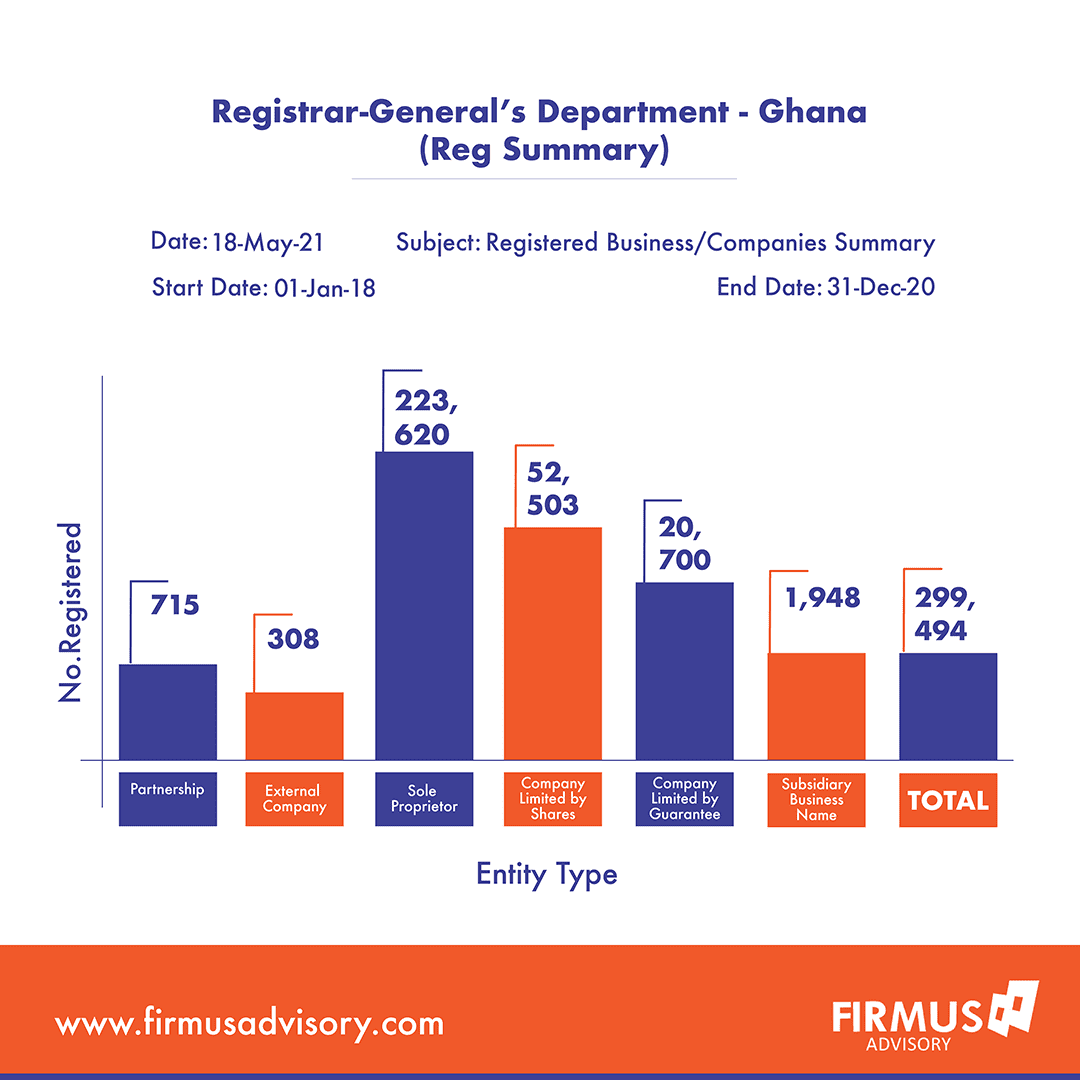
See below statistics of business registrations at the Office of the Registrar of Companies:
READ: BUSINESS REGISTRATION WITH GIPC AS A FOREIGN INVESTOR IN GHANA
What is the cost of registering an External company, Liaison or Representative Office?
The total statutory cost for registering an external company in Ghana is $1,400 This fee is payable directly to the Office of the Registrar of Companies either in dollars or cedi equivalent.
Procedures for registering an External company, Liaison at the Office of the Registrar of Companies.
Applicants may purchase a set of registration forms, form 20 & 21 from ORC Also, all business registration forms can be downloaded at http://https://orc.gov.gh/index.php/forms/
Steps that applicants must undertake include the following;
· Step 1- Company Name Search
A business name, also known as a trading name, is simply a name or title under which a person, or other legal entity trades. Your business name not only identifies you to your customers but also allows you to differentiate yourself from your competitors and enables your customers to make an emotional connection to your business and brand.
The ORC portal offers all users the ability to perform online business/company name searches to ensure the suitability of the proposed name in Ghana before you can proceed with the business registration.
NB; Applicants should note that the final decision on the use and suitability of business and company names rests with the Registrar-General alone.
The ORC may reject names which in its opinion are too similar to existing names, misleading, offensive, and undesirable or violates existing trademarks. It is advisable to submit alternate company names. Be creative with the company names in order to avoid them being all deemed too similar to existing company names or trademarks by the ORC.
· Steps 2- Taxpayer Identification Number
Please note that, for a Ghanaian applicant, you are required to add your Ghana card ID to the complete TIN form. Foreigners are required to attach a copy of the biodata page of their passport. For foreigners who do not reside in Ghana but intends to incorporate a company in Ghana, you must write a letter confirming that you live outside Ghana stating your foreign address. It must be notarized by a notary public in the foreigner’s home country. The letter must be addressed to the Registrar of Companies.
- Bio- data page of passport
- National Identity Card.
- Voter’s Identification Card.
Information required to complete an individual TIN form include;
- Name of applicant
- Occupation
- Photo ID details
- Mother’s maiden name
- Residential and postal
- Contact of applicant
· STEPS 3- Complete External Company Form 20
Information required to complete form 20.
- Name of Company
- Nature of business
- Principal Activity of the Company
- Business Activity Information
- Address of the principal place of business
- Postal Address
- Contacts
- Particulars of local Manager
- Particulars of the person authorized to accept service of process and other documents on behalf of the company.
- Capital Amount (of the parent company)
- Residential address of Manager
- TIN of the Manager.
· STEPS 4 – Complete Form 21 (External Company requiring registration statement that there are no charges on property)
If there are no charges on the property of the company, applicants are required to complete form 21 and write a statement to that effect.
· STEPS 5 – Submission of registration forms
After completing the forms, an applicant should submit the forms at the office of the Office of the Registrar of Companies with an official fee (in cash) of $1,400. It takes between 2 -3 weeks for the registration process to be completed and certificates registration and the company’s profile issued accordingly.
Taxes for External Company, Liaison or Representative Office in Ghana
All External companies except those under The Ghana Free Zones Board are within the tax net of the central government. Below are some of the taxes companies are mandated to pay.
Corporate Tax
Companies operating in Ghana in Ghana are taxed on their worldwide income, taxes are only applied to foreign income that is received in or brought into Ghana. Non-resident companies are taxed on their locally generated income only. The rate of corporation tax is 25%.
Individual Income Taxes/ Pay As You Earn (PAYE)
Currently, the rate of capital gains tax on the disposal of a chargeable asset amounting to a gain of over GH ¢50 is 15%. Dividends are taxed at 8%.
In Ghana, a tax is deducted from an employee’s personal income at source through a ‘pay-as-you-earn’ scheme. The highest income tax rate payable by an individual resident in Ghana is 25%.
It is the employer’s responsibility to file monthly tax returns on behalf of its employees. The employer is required to withhold the employee’s taxes and pay to the Ghana Revenue Authority. The tax withheld must be filed and payment made by the 15th of the month following the month in which the tax was withheld.
Additionally, the employer shall, not later than 30 April following the end of every year of assessment, furnish a return with respect to each person employed by the employer who derives assessable income for the year from the employment. The return is required to outline salaries paid to each employee, exemptions, tax reliefs, chargeable income, tax due and tax paid.
ALSO READ: HOW TO REGISTER A COMPANY LIMITED BY LIABILITY IN GHANA
Frequently Asked Questions
What is an external company in Ghana?
An external company is a body corporate formed outside Ghana that has an established place of business in Ghana. It is essentially a branch of a foreign company. Section 329 of the Companies Act, 2019 (Act 992) defines an external company, and it must be registered with the Office of the Registrar of Companies (ORC) before commencing operations in Ghana.
What is the difference between a branch and a representative office in Ghana?
A branch, registered as an external company, can carry on business in Ghana and earn income from its activities. A representative or liaison office is generally established for non-trading activities such as market research, coordination and communication with the parent company and should not operate as a revenue-generating business in Ghana. Although both may be registered under the external-company regime, their permitted activities and tax treatment can differ. Foreign companies should therefore determine which structure is appropriate for their intended activities before registering.
Which law governs external company registration in Ghana?
External company registration is governed primarily by the Companies Act, 2019 (Act 992). Section 329 defines an external company, while section 330 sets out the documents and particulars required for registration. Section 337 deals with charges on company property. Registration is handled by the Office of the Registrar of Companies (ORC).
Do I need a Local Manager to register an external company in Ghana?
Yes. An external company must appoint a Local Manager who is ordinarily resident in Ghana. The Local Manager does not necessarily have to be a Ghanaian. The parent company must authorise the Local Manager, generally through a power of attorney. A process agent in Ghana must also be appointed to accept service of process and other documents on behalf of the company.
What documents are needed to register an external company in Ghana?
The registration generally requires certified and notarised copies of the parent company’s constitutional documents, together with the prescribed statement containing the company’s particulars. These include details of the company’s name and business, registered office abroad, principal place of business in Ghana, Local Manager, process agent and share particulars, where applicable. Particulars of charges on the company’s property must also be provided, or a statement confirming that there are no such charges.
Is an external company or branch taxed in Ghana?
Yes. An external company that carries on business in Ghana is generally subject to tax on its Ghana-source income. The general corporate income tax rate is 25%, subject to applicable exemptions or special tax regimes. A genuinely non-trading representative or liaison office that does not generate income in Ghana may have a different tax position. However, where its activities create a taxable presence or generate income in Ghana, Ghanaian tax obligations may arise.
Can a foreign company register a branch in Ghana without incorporating a Ghanaian subsidiary?
Yes. A foreign company can establish a presence in Ghana by registering as an external company rather than incorporating a separate Ghanaian subsidiary. An external company is the appropriate route where the foreign company intends to operate in Ghana as a branch, subject to the applicable registration and regulatory requirements.
Does an external company have to be registered with the ORC before starting business in Ghana?
Yes. An external company must be registered with the Office of the Registrar of Companies before commencing business in Ghana. Operating without completing the required registration can result in regulatory and compliance issues.
Does an external company need a Ghanaian shareholder?
No. An external company is a foreign company registered in Ghana as an external company or branch. It does not operate in the same manner as a Ghana-incorporated company with shareholders in Ghana. The foreign parent company remains the entity behind the external company.
Does an external company need a Ghanaian director?
The external-company registration requirements are different from those applicable to a Ghana-incorporated company. The key requirement is the appointment of a Local Manager who is ordinarily resident in Ghana, together with a process agent. The Local Manager does not necessarily have to be a Ghanaian.
Is there a minimum capital requirement for registering an external company in Ghana?
No. An external company is registered as a foreign company under the external-company provisions of the Companies Act, 2019. The GIPA Act 2026 changed the general minimum-capital position for foreign investors, but sector-specific requirements may still apply.
Does the GIPA Act 2026 apply to external companies?
The GIPA Act, 2026 (Act 1173) applies to foreign investment activities within its scope, but the registration of an external company itself is governed by the Companies Act, 2019 and handled by the ORC.
Can an external company carry on trading activities in Ghana?
Yes. An external company or branch can carry on business in Ghana, subject to the laws and regulatory requirements applicable to its particular activities. Where the business involves regulated activities, the company may also need to obtain additional licences or approvals from the relevant regulator.
Can a representative office make sales in Ghana?
A representative or liaison office is generally intended for non-trading activities such as market research, liaison, coordination and supporting the parent company’s activities. It should not operate as a revenue-generating business in Ghana. If the proposed activities involve selling goods or services or generating income, the foreign company should consider whether a branch or Ghanaian subsidiary would be more appropriate.
Can an external company open a bank account in Ghana?
An external company may open a corporate bank account in Ghana, subject to the requirements of the relevant bank and applicable regulatory requirements. The bank will typically require evidence of the company’s registration, details of its Local Manager and other corporate and identification documents.
How long does it take to register an external company in Ghana?
The processing time depends on the completeness of the application, the documents submitted and the ORC’s current processing timelines.
How much does it cost to register an external company in Ghana?
The cost for registering an external company in Ghana is US$1,400.
Can an external company employ expatriates in Ghana?
Yes, an external company may employ expatriate staff where their skills are required, but the relevant immigration and work-permit requirements must be satisfied. Registration as an external company does not by itself give an expatriate the right to work in Ghana. The company must comply with the applicable requirements for work permits and immigration status.
What is the main difference between an external company and a Ghanaian subsidiary?
An external company is an extension or branch of a foreign company registered in Ghana, while a subsidiary is a separate Ghanaian-incorporated company. The choice between the two depends on factors such as the intended business activities, liability considerations, tax treatment, regulatory requirements and the foreign company’s preferred structure for operating in Ghana.
Conclusion
Registering an external company, liaison or representative office in Ghana is not a difficult process. There are forms to be completed with relevant information, payment made at the RGD and then documents will be processed within 2 to 3 weeks of submission.
We hope you found the guidelines useful.


8 Responses
Thanks Dree! 🙂
So how does foreign company differ from external company
I am a professional law student and your page is very helpful in my study of company and commercial practice. Well done guys!
Thanks Wendy, we’re glad you found our content useful for your studies. We would be extremely glad if you could share our links with your colleagues. Cheers!
Thank you for all the Informations.
You are welcome, always at your service.
Got everything like 100%
Thank you
Very insightful read and also straight to the point.
Many Thanks