


What Is a Private Company Unlimited by Shares?
A private company unlimited by shares, under the Companies Act, 2019 (Act 992), is a company in which the liability of its members is unlimited. A private unlimited company is one of the types of companies recognised under section 7 of the Act. Although the company has separate legal personality, its members have an unlimited obligation to contribute towards the liabilities of the company where the company is unable to meet its obligations, particularly upon liquidation.
Simply put, an unlimited liability is one in which the liability of the shareholders for the debts of the company is unlimited. The company remains a separate legal entity from its members and can own property, enter into contracts and incur liabilities in its own name. What distinguishes an unlimited company is that the liability of its members is not capped in the same way as that of members of a limited company. Where the company is unable to meet its liabilities, members may be required to contribute towards any shortfall in accordance with the law, particularly upon liquidation. There is maximum exposure to risks.
Unlimited liability is the exact opposite of the limited liability where the liability of the investors or owners of a company is limited to the amount of money that they have contributed or invested in the business.
Countries that have unlimited liability companies include the United Kingdom, Ireland, Hong Kong, Pakistan, Nigeria, India, Australia, New Zealand and other jurisdictions where the company law is derived from English law. They can also be found in Germany, France, Macao, Czech Republic and in three jurisdictions in Canada (Alberta, British Columbia, and Nova Scotia), where they are called unlimited liability corporations.
Who can register a Private Company Unlimited by Shares?
So why would anyone accept unlimited personal liability on purpose?. In Ghana, certain regulated professions are required to operate through a private company unlimited by shares. These include professions such as law, auditing and architecture, where applicable professional and regulatory requirements make this structure appropriate. Foreigners are also permitted to own an unlimited liability company, subject to applicable Ghanaian laws and regulatory requirements.
Limited vs Unlimited: The Real Differences
Incorporation status and most day-to-day obligations are the same for both. The key differences are summarised below;
Limited by shares | Unlimited by shares | |
Members’ liability | Capped at unpaid share amount | Unlimited — personal assets exposed on liquidation |
Name ends in | “Limited” / “Ltd” | “Private Unlimited Company” / “PRUC” |
Audited accounts with annual return | Required | Not required — greater privacy |
Typical users | Most businesses | Professional firms (law, audit, architecture) |
Governing law | Companies Act 2019 (Act 992) | Companies Act 2019 (Act 992) |
The benefits and incorporation status of an Unlimited liability company is the same as its limited liability counterpart. However, the reason for choosing unlimited liability as an alternative business model is due to the ability to shield its financial affairs from the public, media and industry competitors. Unlimited liability companies are not obligated to give out the state of their finances to an outsider. This prevents the general public from probing into the affairs of the company. The unlimited liability structure may provide greater assurance to creditors because members may have to contribute towards the company’s liabilities if the company’s assets are insufficient, particularly upon liquidation. However, this does not mean that the company and its members are the same legal person. The company remains a separate legal entity, while the members’ liability is unlimited in accordance with the applicable provisions of the Companies Act.
An unlimited company remains subject to the applicable ongoing requirements under the Companies Act, including requirements relating to annual general meetings, annual returns, amendments to company particulars and beneficial ownership disclosures. The company must continue to comply with its statutory filing and corporate governance obligations.
How to Register a Company Unlimited by Shares
To ensure smooth registration and incorporation of an unlimited liability company, there are steps to follow through;
Step 1- Search and reserve your company name
To register any company in Ghana, a name search needs to be conducted to ensure the availability of the proposed business name for the company. After the name search, company promoters may apply to have their business name reserved for a period of 30 days. The business name must be meaningful, relevant and distinctive. Business names that are too similar to existing names are likely to be rejected by the Office of the Registrar of Companies However, applicants will be advised to amend their company name accordingly. The choice of a business name must be relevant to the nature of activity of the company. Moreover, the business name must not be offensive and undesirable or violate existing trademarks.
STEP 2 – Taxpayer Identification Number (TIN) registration
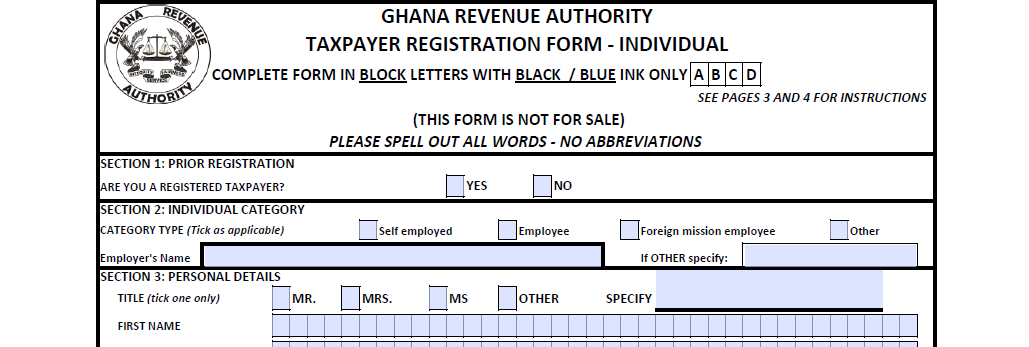
All company directors, secretaries and shareholders are required to register and obtain a TIN. TIN forms must be completed with a copy of photo ID added. TIN numbers are created at any Ghana Revenue Authority office at gratis within 24 to 48 hours. Corporate organizations or entities require TIN numbers. In the event where the shares of the company being registered belong to a corporate entity, the entity will fill an organizational TIN form and attach a letter of introduction. A TIN number will subsequently be created for the corporate shareholder. Information required to complete an individual TIN form include;
- Name
- Occupation
- Photo ID details
- Mother’s maiden name
- Residential and postal address
- Contact
TIN forms are downloaded from the Ghana Revenue Authority website or the ORC website. Quick links include;
https://gra.gov.gh/index.php/download-tin/
STEP 3 – Completing the Registration Forms
The main registration form is Form 3, which captures the company’s name, business activities, registered and principal office, digital address and the personal and tax details of the directors, secretary and shareholders. The registration process also requires the relevant consent forms for the directors and secretary, the statutory declaration and the Beneficial Ownership forms. Under the Companies Act, an unlimited company must have at least two directors, with at least one ordinarily resident in Ghana, and a qualified company secretary.
CHECK OUT OUR: HOW TO REGISTER A COMPANY LIMITED BY SHARES
STEP 4. Pay stamp duty, business incorporation and filing fees
Two statutory charges apply: the incorporation and filing fee, currently GHS 585 on ORC’s service page, and stamp duty of 1% of your stated capital. The stamp duty is easy to compute — for example, a stated capital of GHS 100,000 means stamp duty of 1% × 100,000 = GHS 1,000. Both are paid at the ORC in-house bank or online via ghana.gov.gh.
STEP 5 – Collect Business registration documents
One should expect to have the process completed in 2 weeks, upon submission of forms. The following documents will be issued;
- Certificate of incorporation
- Form 3
- Beneficial Ownership Details
- Constitution
These are the legal documents of proof of company’s existence in Ghana. The documents will indicate clearly the business name, activities, business address, directors’ details, company TIN as well as shareholders information among others. The business certificates can be used for any business transaction or open a corporate bank account with any of the commercial banks in Ghana.
After Incorporation: AGMs, Annual Returns and Amendments
As noted, an unlimited company carries the same ongoing obligations as a limited one — with the single exception of the audited-accounts privacy point above.
- Annual General Meetings. Hold an AGM each year, with no more than 15 months between one and the next. A new company can hold its first AGM within 18 months of incorporation.
- Annual returns. File annual returns with ORC — the first within 18 months of incorporation, then yearly. The current ORC fee is GHS 175. File on time to avoid penalties and the risk of being struck off.
- Changes to your address, directors, name, activities or stated capital are filed at ORC with the relevant forms and a signed resolution. Note you cannot amend an unlimited company into a limited one — the Act prohibits that conversion by amendment.
READ ALSO – HOW TO FILE ANNUAL RETURNS IN GHANA
How FIRMUS Advisory Helps
Unlimited companies are a specialist corner of company registration, and getting the structure and the constitution right matters — especially for professional firms. We handle the whole thing: the name search, the forms, the right constitution for a private unlimited company, GIPA registration for any foreign owners, and the after-care of annual returns and AGMs. If you’re a lawyer, auditor or architect setting up your practice — or anyone weighing this structure — we’ll make sure it’s done properly.
Need to register an unlimited liability company? Let FIRMUS handle the incorporation, GIPC, and compliance end to end. WhatsApp +233 57 646 1118 · info@firmusadvisory.com · 17 Swaniker St, Abelemkpe, Accra
Frequently Asked Questions
What is a private company unlimited by shares in Ghana?
A private company unlimited by shares is a type of company recognised under section 7 of the Companies Act, 2019 (Act 992). Its members have unlimited liability for the company’s obligations, subject to the provisions of the Act, including the rules governing liability upon liquidation.
Who needs to register an unlimited liability company?
Mainly regulated professionals who can’t use limited liability — in Ghana, typically lawyers, auditors and architects.
What’s the difference between a limited and an unlimited company?
In a limited company your liability is capped at the unpaid amount on your shares. In an unlimited company there’s no cap — your personal assets can be reached on liquidation. The unlimited company also isn’t required to file audited accounts with its annual return.
Can a foreigner own an unlimited liability company in Ghana?
Yes. Foreigners may own one, subject to the same GIPA minimum-capital requirements that apply to any foreign-participation company.
How much does it cost to register an unlimited company in 2026?
For a 100% Ghanaian-owned company at the GHS 500 minimum capital, around GHS 585 for the ORC fee plus 1% stamp duty.
How is stamp duty calculated?
1% of your stated capital — for example, GHS 100,000 of stated capital means GHS 1,000 in stamp duty.
How long does registration take?
Roughly 10 to 15 working days with clean, complete documents. Queries over incomplete information are the main cause of delay.
What name ending must an unlimited company use?
It must end in “Private Unlimited Company” or the abbreviation “PRUC.”
Is an unlimited company really more private than a limited one?
To a degree — it isn’t required to file audited financial statements with its annual returns, so its detailed accounts aren’t publicly available. But it still files beneficial-ownership information like every other company.
What documents do I receive after registration?
A Certificate of Incorporation, a certified copy of your Constitution, your Form 3, and your Beneficial Ownership Profile.
How many directors does an unlimited company need?
At least two directors, with one ordinarily resident in Ghana, plus a qualified company secretary — under the Companies Act 2019 (Act 992).
What law governs unlimited companies in Ghana?
The Companies Act 2019 (Act 992) — the unlimited company is defined at Section 7(2)(c), and its constitution form at Section 27.
Can a private unlimited liability company have only one shareholder?
Yes, a private unlimited liability company can have only one shareholder.
Does an unlimited company have to file annual returns in Ghana?
Yes. A private unlimited company must file its annual returns with the Office of the Registrar of Companies (ORC). The first annual return is generally filed within 18 months of incorporation, followed by annual filings.
Does an unlimited company have to hold an Annual General Meeting (AGM)?
Yes. An unlimited company is subject to the applicable requirements of the Companies Act concerning Annual General Meetings. A company should ensure that its AGM is held within the statutory time limits.
Are the directors of an unlimited company personally liable for the company’s debts?
Not simply because they are directors. The company remains a separate legal entity, and directors do not automatically become personally liable for every company debt. The distinctive feature of an unlimited company is the unlimited liability of its members, particularly where they are required to contribute towards a shortfall in the company’s assets upon liquidation.
Can an unlimited company be used for any type of business in Ghana?
An unlimited company may be used for businesses permitted under Ghanaian law, but certain regulated professions may be required to use this structure. Professional and sector-specific regulations should therefore be considered before deciding whether to register an unlimited company.
Conclusion
Though registering unlimited liability company is not as common as the registration of other types of companies, we believe that having a widened scope and knowledge on all types of business registrations is important. We hope this article provides the needed information and steps on how to register an unlimited liability company. We will be delighted to read your comments and answer all questions.


One Response
Thankfulness to my father who shared with me regarding this web site,
this blog is really amazing.